
Family Help
At Webheath Academy Primary School we recognise the challenges that families face in bringing up children. There may be times when you need extra help and support. If this is the case please come and talk to us. There are many ways in which we can help .
Please see below our Family Help offer in Webheath for 2026 plus resources available to parents in Worcestershire through our County Council.
If you need a paper copy or further advice please contact the school office on 01527 544820 or via email on office@waps.shiresmat.org.uk
Family Help Webheath 2026
High-quality teaching is at the heart of everything we do. Our teachers adapt their teaching to meet the needs of all learners, ensuring that every child is supported, challenged, and encouraged to achieve their best.
We believe that strong relationships are key. By getting to know each child as an individual and maintaining positive communication with families, class teachers work in partnership with parents to support children's academic progress, wellbeing, and confidence. Together, we create a safe, nurturing environment where every child can thrive. Teachers are your first port of call for any concerns and are always keen to support your child in any way that they can.
We believe that children achieve their best when school and home work together. Open, honest communication between parents and school helps us to understand each child's strengths, celebrate successes, and provide support when challenges arise. We encourage parents to speak to their child's class teacher whenever they have questions or concerns, as early conversations often help us to put the right support in place quickly.
If your family would benefit from additional support, the following services offer advice and guidance on wellbeing, parenting, mental health, and family life:
Local Support
- Worcestershire Family Hubs - information, advice, parenting support, groups and services for families. https://www.worcestershire.gov.uk/familyhubs [worcesters...ire.gov.uk], [worcsalliance.org]
- Worcestershire Virtual Family Hub - online resources covering wellbeing, mental health, parenting, SEND, finances and more. https://www.worcestershire.gov.uk/virtualfamilyhub [worcesters...ire.gov.uk]
- Family Front Door - support and guidance for families who may need additional help or advice. https://www.worcestershire.gov.uk/family-front-door [worcesters...ire.gov.uk], [worcesters...ire.gov.uk]
National Support
- NHS Every Mind Matters - practical advice and resources to support mental wellbeing for adults, children and families. https://www.nhs.uk/every-mind-matters/ [nhs.uk], [nhs.uk]
- YoungMinds Parents Helpline - free advice and support for parents concerned about their child's emotional wellbeing or mental health. https://www.youngminds.org.uk/parent/ [youngminds.org.uk], [youngminds.org.uk]
- Family Lives - support, advice and parenting guidance for families. https://www.familylives.org.uk
This list is not exhaustive. If you are unsure where to go for support, please contact the school office or your child's class teacher and we will be happy to help direct you to appropriate services.
The School Nursing Service provides advice, support and guidance to children, young people and their families on a wide range of health and wellbeing matters. This can include support with emotional wellbeing, sleep, healthy lifestyles, toileting, continence, relationships, medical needs, puberty, and other health concerns that may affect a child's learning or daily life.
School nurses work closely with schools, families and other professionals to help children stay healthy, safe and ready to learn. They can offer advice, signpost families to additional services and provide support when concerns arise.
How to Contact the School Nursing Service
Parents and carers can contact the School Nursing Service directly for advice and support. You can also speak to your child's class teacher or the school office if you would like help making contact.
Worcestershire School Health Nursing Service
- Telephone: 01905 520032
If you are unsure whether the School Nursing Service can help, please get in touch. They are always happy to discuss concerns and advise on the most appropriate support available.
We can offer support for Food Bank vouchers through our school nurse as one of our offers.
At our school, we use the Jigsaw PSHE programme to deliver a comprehensive, age-appropriate curriculum that supports children's personal development, wellbeing, relationships education and understanding of the world around them.
Through Jigsaw, pupils develop the knowledge, skills and attitudes needed to become confident, responsible and respectful members of society. The curriculum is taught through six key themes:
- Being Me in My World - understanding rights, responsibilities and belonging.
- Celebrating Difference - promoting respect, diversity and inclusion.
- Dreams and Goals - developing resilience, aspirations and perseverance.
- Healthy Me - learning about physical health, mental wellbeing and healthy lifestyles.
- Relationships - building positive friendships, family relationships and communication skills.
- Changing Me - understanding growth, change and age-appropriate relationships and health education.
Our PSHE curriculum helps children develop confidence, emotional literacy, resilience and positive relationships, ensuring they are well prepared for life both within and beyond school. We encourage children to reflect on their values, understand their emotions and make safe, informed choices.
Keeping children safe online is a key part of our curriculum and wider safeguarding responsibilities. Through our Jigsaw PSHE programme, pupils learn how to use technology safely, respectfully and responsibly. Online safety is taught throughout the year and reinforced through dedicated lessons, assemblies and national events such as Safer Internet Day.
As part of their learning, children explore the 4 Cs of Online Safety:
- Content – understanding how to access age-appropriate content and what to do if they encounter material that is upsetting, harmful or misleading.
- Contact – learning how to stay safe when communicating online and recognising when interactions may be unwanted or inappropriate.
- Conduct – developing positive online behaviour, showing respect for others and understanding the impact of their actions in the digital world.
- Commerce – understanding online spending, advertising, scams and how to make safe choices when using websites, apps and games.
Children also learn about:
- Keeping personal information safe online
- Creating positive digital footprints
- Managing online friendships and communication
- Cyberbullying and how to report concerns
- Healthy screen time habits
- Evaluating the reliability of online information
To help keep pupils safe when using technology in school, we have robust filtering and monitoring systems in place. These systems help prevent access to inappropriate content and alert designated safeguarding staff to potential concerns, enabling timely support and intervention where necessary. Filtering and monitoring arrangements are regularly reviewed to ensure they remain effective and meet current safeguarding requirements.
We encourage parents and carers to take an active interest in their child's online activity. By working together, home and school can help children develop the knowledge, skills and confidence they need to navigate the online world safely, responsibly and respectfully.
We encourage families to work with us to help children stay safe online. The following organisations provide trusted advice, guidance and practical resources for parents and carers:
- CEOP (Child Exploitation and Online Protection Centre) – advice on online safety and how to report concerns about online exploitation. https://www.ceopeducation.co.uk/parents/ [nhs.uk], [nhs.uk]
- NSPCC Online Safety – guidance for parents on apps, games, social media, privacy settings and online risks. https://www.nspcc.org.uk/keeping-children-safe/online-safety/
- Internet Matters – age-specific advice, parental controls and practical online safety guides for families. https://www.internetmatters.org/
- UK Safer Internet Centre – resources and advice to help children and young people use technology safely and responsibly. https://saferinternet.org.uk/
- Childline – support and advice for children and young people who are worried about anything they have experienced online. https://www.childline.org.uk/
- Thinkuknow – educational resources from CEOP to support children and parents in staying safe online. https://www.thinkuknow.co.uk/
If you have any concerns about your child's online safety or digital wellbeing, please contact your child's class teacher or a member of the safeguarding team. We are committed to working in partnership with families to ensure that all children can enjoy the benefits of technology safely and confidently.
Our families with children on the SEND register, also have extra advice and guidance that can be offered through our specialist Special Educational Needs and Disability Co-ordinator (SENDco), Mrs Jayne Woodward. She can be contacted through the school office, and she has drop ins, coffee mornings and can offer signposting and support to a range of services. As you can imagine, she is in demand but we always try to support when possible.
We are very fortunate to be able to boast our very own family support worker, Lisa Sinclair. She is independent but spends a day a fortnight at Webheath Acdemy Primary School. Support can be referred through school through one of our designated safeguarding leads.

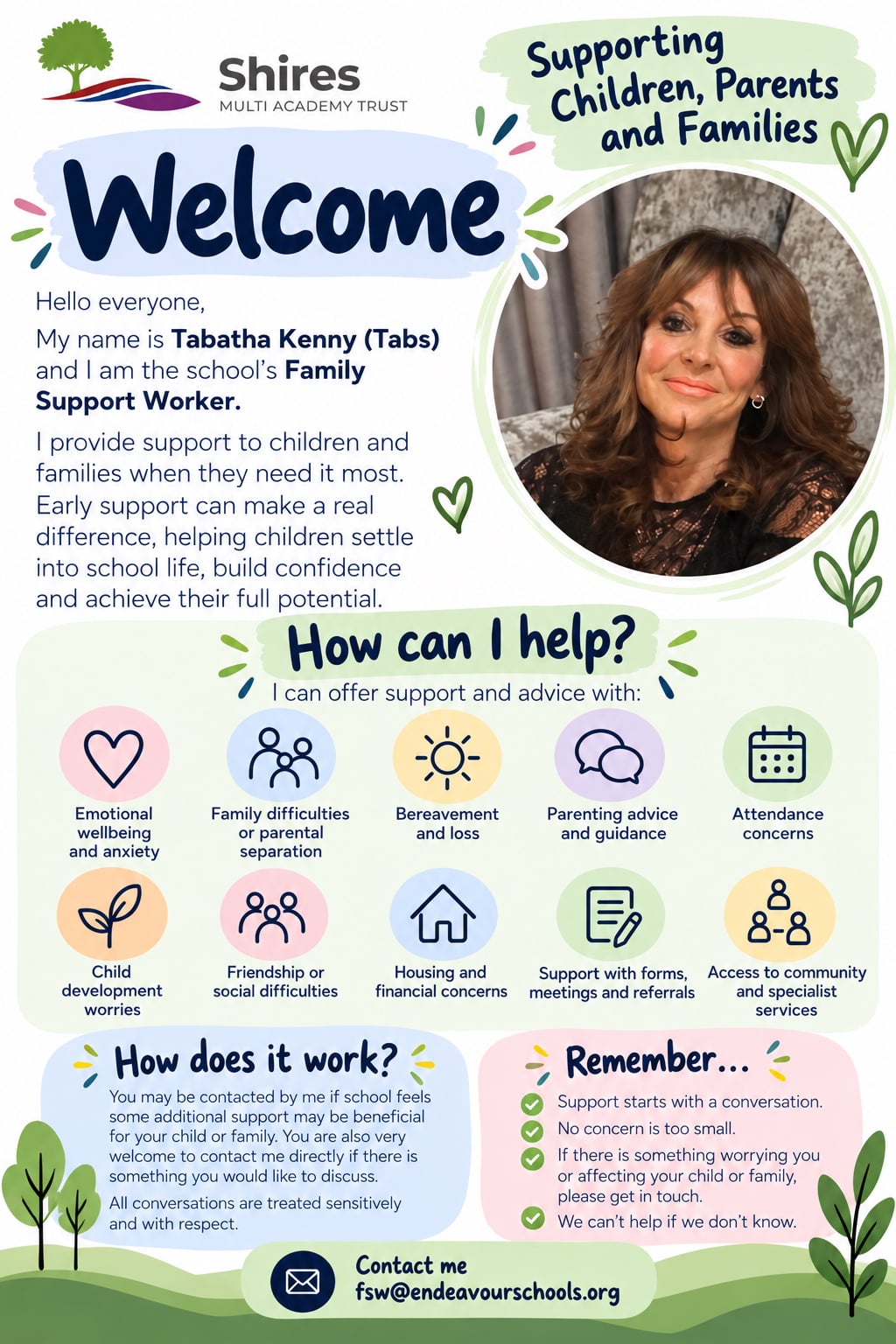

We can signpost via our Early Help offer to local charities, agencies and support partners locally.
Dr Daniel Rouse is our Educational Psychologist who we hold a Service Level Agreement with. Internal referrals to Daniel are managed by Mrs Jayne Woodward, our SENDco.
We use the Solutions Focused approach in Mentoring to develop young people and see them find the solutions they need for the challenges they face in their bespoke situations. This builds upon the development of CBT (Cognitive Behavioural Therapy) and according to Mark Beyerbach’s research in Spain, the approach not only increases a young person’s sense of self-efficacy but changes their thinking patterns at home as well as at school. We believe mentoring has the potential to refocus attention on to an individual’s own strengths and can empower them to make positive decisions for themselves that will build confidence and responsibility.
We offer courses within school and as a Trust about Online Safety, supporting your children in school, community events and aim to be a hub of support and information. Our nhs offer some excellent signposting and parenting courses Parenting workshops, courses and groups | Starting Well (startingwellworcs.nhs.uk)